Kobane: The Comma Has Reached Damascus
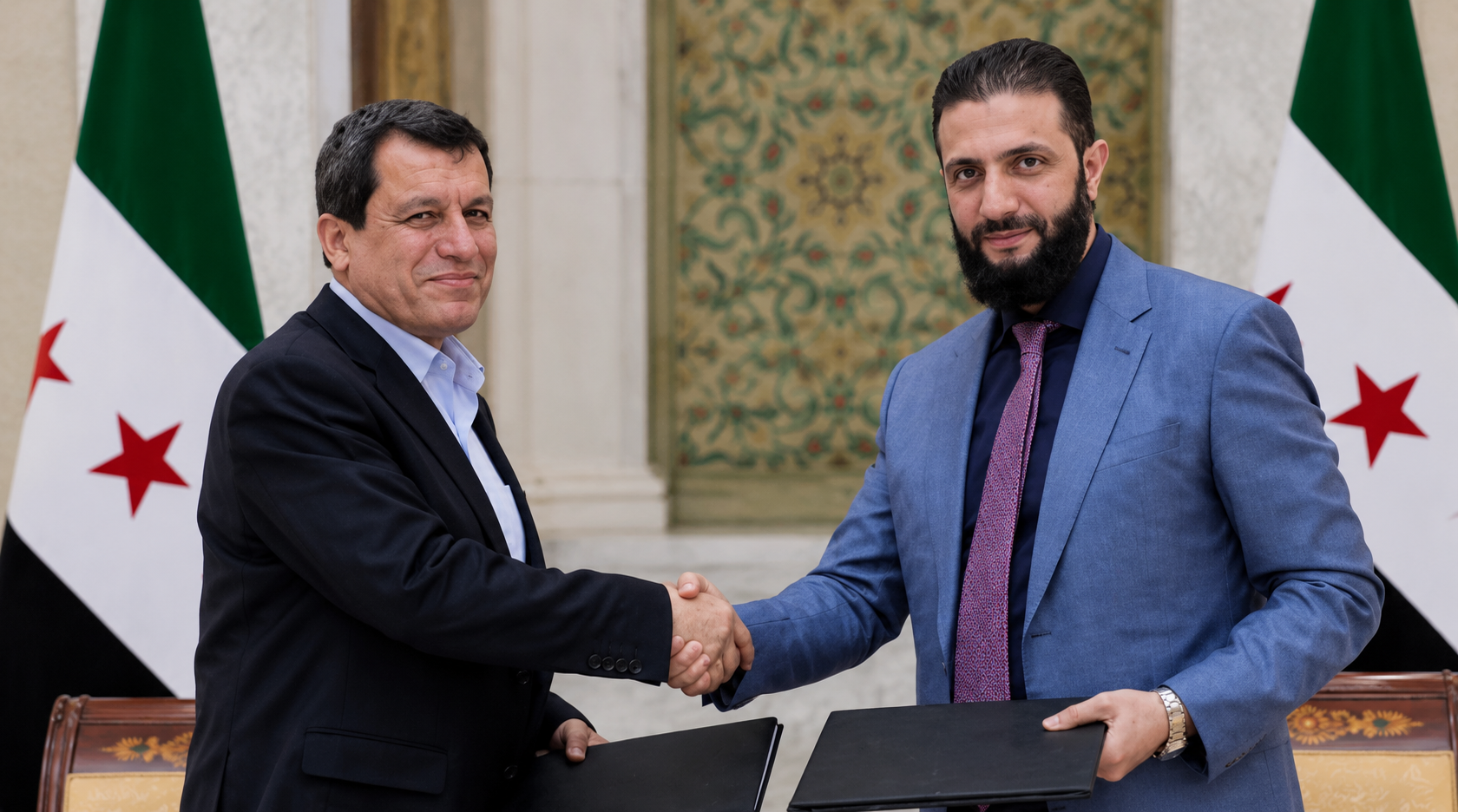
The SDF have entered the Syrian state. Now the Kurds and Damascus are negotiating over the constitution, schools, the YPJ and power itself. Kobane’s revolution has left the battlefield and entered the ministries.
In January 2015, Kobane was celebrating. There was not much left to celebrate with. The city had been torn open, houses stood like boxes without lids, and the streets were buried under rubble. But Islamic State had been driven back.
The photographs travelled around the world: men and women of the YPG and YPJ, uniforms that seemed to belong more to the dust than to an army, fingers raised in victory. For a few months, everyone learned a word that most people had barely known how to pronounce the day before: Kobane.
The United States and the coalition had repeatedly bombed ISIS positions around the city. By October 2014, CENTCOM had already carried out more than 135 air strikes in the area and organised airdrops of weapons, ammunition and medical supplies for the Kurdish fighters. The Americans were in the sky. On the ground, however, were the Kurds.
Eleven years later, on 25 August 2026, Mazloum Abdi announced the dissolution of the Syrian Democratic Forces as an independent military force. They had not been destroyed and had not signed a surrender. After the government offensive in January and months of negotiations, their fighters were entering the Syrian state forces. The YPG, the main Kurdish component of the SDF, had already been incorporated into the new military structure. Sipan Hamo had become deputy defence minister for the eastern regions.
Three days later came an even more curious photograph. Syrian President Ahmed al-Sharaa appointed Mazloum Abdi as an adviser. For more than a decade, Abdi had commanded the army that built and defended an autonomous territory beyond Damascus’s control. Now he had a title inside the Syrian presidency. Reuters noted that it remained unclear whether the appointment would carry real political weight or prove largely symbolic. The question is still worth asking. Titles take up considerably less room than armies.
It was tempting, at that point, to declare the Kobane revolution over. It would also have made an excellent headline. Revolutions, unfortunately, are not very considerate of headlines.
First the hill, then the comma
What emerged in northern Syria during the war was never just the SDF. Behind the uniforms grew local councils, administrations, a co-presidency system pairing a man and a woman, autonomous women’s organisations, Kurdish-language schools and a political experiment inspired by democratic confederalism.
It was not a Kurdish state, nor did it formally aspire to become one. It was something rather harder to explain on television and, quite possibly, harder to govern. As long as ISIS was there, the problem was relatively simple. A hill had to be defended. Now it is a comma.
Because when autonomy enters a state, words suddenly acquire the precision of legal instruments. A language can be national or official. It can be taught, or children can be taught in it. An armed force can be integrated or dissolved. A right can appear in a presidential decree or in the constitution. And a YPJ fighter can enter the forces of the Syrian state. The question is whether she can do so and remain YPJ.
Three hours of Kurdish
To find out what has become of Kobane’s revolution, it helps to leave presidents and generals alone for a moment. A school will do.
For decades under the Baathist rule of the Assads, Kurdish had no place in Syria’s public education system. During the years of self-government, the opposite happened: in Kurdish-held areas, a school system emerged in which thousands of children could study in their own language.
In 2026, Damascus did something that would be unfair to dismiss as cosmetic. Decree No. 13 recognised Kurdish as a national language. The Education Ministry introduced Kurdish into schools in areas with significant Kurdish populations and began integrating the former autonomous education system. The revised implementing rules provided three Kurdish-language periods each week and allowed some humanities subjects to be studied in Kurdish during the transition. Mathematics and science remain in Arabic.
That is not nothing. The trouble is that it is not the same thing. For a girl who has learned mathematics in Kurdish since primary school, the distinction between teaching Kurdish and teaching in Kurdish requires no seminar in linguistics.
Mazloum Abdi raised the stakes further, calling for Kurdish to have official status and remain a language of instruction. Then, on 2 October, he went to Damascus. Not to discuss Kurdish identity in the abstract.
He met Education Minister Mohammad Abdulrahman Turko. According to Syria’s state news agency SANA, the agenda included implementation of Decree No. 13, Kurdish-language textbooks and the teachers needed to teach the language. Books are a curious form of progress. First you win the right to a language. Then somebody has to print it.
We still do not know how far those books will travel. Damascus speaks of teaching the Kurdish language. Abdi wants education in Kurdish. The preposition is small. The school rather less so.
That same day, Abdi also met the higher-education authorities to discuss universities, degrees, students and staff from the years of self-government. This is the least photogenic part of integration. A young man may have spent four years studying medicine or engineering under an administration that no longer exists in quite the same form. The new state must decide whether those four years exist. Revolutions sometimes end up at a ministry carrying a folder full of paperwork.
The discussion has already moved beyond recognition in principle. A ministerial committee is assessing how Kobane University can be incorporated into Syria’s state university system, with its programmes expected to enter the national admissions framework. Damascus has also indicated that degrees issued by the university will be recognised and certified. The question is no longer whether the institution exists. It is what will remain of it once the state puts its name on the door.
Then al-Sharaa said the word
On 22 September, Ahmed al-Sharaa was in New York for an Atlantic Council event. He was asked whether the cultural and linguistic rights granted to the Kurds would be included in the future constitution. Al-Sharaa said yes.
He did not announce a constitution already written, nor specify exactly which rights would be protected or by what mechanisms. The distinction matters. Kurdish rights are not currently guaranteed by a new Syrian constitution. That constitution does not yet exist. But Syria’s president has publicly committed himself to putting them there.
For anyone who knows the history of Syria’s Kurds, that is difficult to dismiss as a detail. For anyone who knows the history of constitutional promises, it is equally difficult to treat it as an achievement already secured.
Within days, the Kurdish question had travelled in both directions. In New York, a president spoke about a future constitution. In Damascus, a former Kurdish commander discussed schoolbooks. Kobane lies somewhere between the two. And on Monday morning, somebody will still have to open a notebook.
The women who do not fit into the army
In 2014 and 2015, the West fell in love with Kurdish women fighters with almost suspicious speed. A young woman, hair loose, rifle in hand and ISIS somewhere in front of her worked magnificently on magazine covers. Far less photogenic was everything behind her: co-presidency, autonomous women’s organisations, women inside political institutions, and the proposition that a woman should not merely fight beside a man but be able to make decisions without him.
The rifle was what the camera could see. The revolution was elsewhere.
That was what the YPJ represented before they became a Western icon. They were not simply the female version of a male army, but an armed expression of a political project in which women’s liberation was treated as part of political transformation. That is why their place in the new Syria matters rather more than a box on a security-service organisational chart.
After the dissolution of the SDF, the YPJ sought entry into the new Syrian military while retaining an organised structure of their own. Damascus refused. Commander Nowruz Ahmed told Reuters that the unit’s proposal for a structured female brigade had been rejected. A second negotiation opened with the Interior Ministry, where the YPJ sought an organised role in special operations.
The point is not simply to find jobs for former fighters. The YPJ want to retain an organised structure, a command and therefore some of the political autonomy that the uniform came to represent. A woman can join the Syrian police. A former fighter can put on another uniform. But can fifteen hundred women enter the state and still be the YPJ? So far, Damascus has not said yes.
The prison
Then came the fire. In mid-September, a revolt and fire at Kobane prison left at least seven people dead, according to Associated Press. The prison was still being administered by Kurdish forces while Syrian state institutions were returning to the city, and inmates reportedly feared transfer to Aleppo.
The episode matters for a reason larger than the prison itself. Who has the keys? Who can transfer a prisoner from Kobane to Aleppo? Who gives an order, who carries it out, and who investigates when something goes wrong? These are less noble questions than democratic confederalism. They also have the unfortunate habit of being the questions through which a state proves that it exists.
In 2015, to know who held Kobane, you only had to look at who was holding the line against ISIS. In 2026, you have to ask who has the keys to a cell.
And while Kobane argued over who might leave a prison, a few hundred kilometres away other people were trying to make the opposite journey: going home.
Seven hundred families
In early September, around 700 displaced families from Ras al-Ain and its countryside prepared to return home. It was the second organised return after the August convoy of 413 families. Syrian officials said around 12,500 families from the area were still displaced in Hasakah.
The figures matter because return is not the same as a convoy photograph. We do not yet know how many families will manage to rebuild their lives in houses and villages abandoned years ago, or how safe and sustainable the conditions will prove to be.
But when a family travels back along the road it once used to flee a war, the movement deserves to be noticed. Sometimes facts have the good manners not to require an adjective.
Petrol gets a vote too
Integration has also met an opponent that does not appear in constitutions: the price of fuel. The return of state institutions and the erosion of earlier subsidies have made the cost of daily life part of the political argument. A constitutional settlement can look rather different from behind a fuel pump.
Revolutions are rather fond of constitutions. People, with tiresome persistence, still have to buy diesel.
Washington moves its chair
And then there are the Americans. They were indispensable at Kobane. Coalition aircraft struck ISIS positions while the YPG and YPJ held the ground; in the years that followed, the SDF became Washington’s principal ground partner in the war against Islamic State. It was a very practical alliance: intelligence, weapons, training and air support.
It was not a marriage. This might have been useful to remember during the engagement.
On 1 October 2026, Washington took a step that measured how much the room had changed. The State Department removed Syria from the ITAR list of countries subject to a general policy of denial for licences involving defence articles and services. That does not mean the United States has decided to arm Damascus. It means future applications can be considered case by case.
In 2014, the United States supplied weapons to Kurds resisting ISIS at Kobane. Twelve years later, it has opened the legal possibility of considering military transfers to the Syrian state those Kurdish forces have just entered.
Calling this betrayal would be convenient but imprecise. Washington never promised the Kurds a state, and its alliance with the SDF was built first and foremost around the war against ISIS. The American chair has not been left empty. It has moved to the other side of the table.
Friendships between states differ from friendships between people in one useful respect: they can change address without returning the photographs.
And Turkey watches
Then there is Ankara. For years, Turkey has regarded the YPG, the main Kurdish component of the SDF, as the Syrian extension of the PKK and therefore a threat to its security. It fought to prevent Kurdish expansion along its border, occupied territory in northern Syria and welcomed the dissolution of the SDF as an autonomous military force.
It would therefore be natural to imagine Ankara sitting outside the room, waiting for the result. Naturally, it is not.
Kurdish officials have spoken openly about channels with Turkey. Mazloum Abdi has called for relations with Ankara to move onto a “normal and constructive” footing. This is not yet reconciliation. Turkey continues to regard Kurdish armed structures as a security problem and maintains a military presence in northern Syria. But the fact that Kurdish leaders can publicly discuss normalising relations tells us how quickly the floor has shifted beneath everyone’s feet.
In 2019, Turkish forces and their allies entered Serêkaniyê/Ras al-Ain and tens of thousands fled the area. In September 2026, some of those families began returning while Kurdish representatives discussed the possibility of speaking directly to Ankara. History has very little respect for symmetry. Fortunately.
A promise in New York, a book in Damascus
We could draw up the balance sheet now. The SDF have entered the Syrian military. Abdi has become a presidential adviser. Al-Sharaa has promised that Kurdish cultural and linguistic rights will enter the future constitution. The YPJ are still looking for a way to enter the state without disappearing inside it. Families are returning towards Ras al-Ain. A prison fire in Kobane exposed the uncertain frontier between local and central authority. Washington has changed its posture towards Damascus. Ankara is talking to people it once preferred to describe simply as a security problem.
Put like that, it almost sounds like an assessment. I would rather not make one.
Because on 2 October, Mazloum Abdi walked into the Education Ministry in Damascus to talk about schoolbooks. There is something almost disproportionate about the scene. A man who commanded tens of thousands of fighters and negotiated with American generals, Syrian presidents and officials across the Middle East is now discussing textbooks and teachers. Perhaps the disproportion is ours.
In 2015, Kobane’s survival depended on who controlled a hill. In 2026, part of its future depends on what gets printed on a page. Al-Sharaa has promised that Kurdish rights will enter the constitution. Abdi wants Kurdish to become an official language and remain a language of instruction. Damascus has recognised the language and arranged for it to be taught, but it has not accepted everything the Kurds are asking for.
Between those positions there is more than a political negotiation. There is a child. On Monday morning, that child will walk into a school in Kobane. There will be a teacher, books, perhaps three hours of Kurdish that week. When mathematics begins, somebody will already have decided which language will be used to explain division.
For a state, that is a very small decision. For a language, rather less so.
In 2015, Kobane showed that a city which appeared lost could survive. In 2026, it has to demonstrate something less heroic and probably more difficult: whether things won during a war can survive peace without being preserved in a museum.
Some will be lost or absorbed; others may have to change their names to survive. And some, perhaps, will eventually find their way into the Syrian constitution. We do not yet know how much. So I would hold off on both the champagne and the obituary.
First there was a hill to defend. Then a comma. Now we have to see what gets written after the comma. And, for once, I would start with the mathematics book.

Samuel Pes
Amo la storia e la geopolitica perché mi piace capire cosa muove le persone, i Paesi e le scelte che cambiano il mondo. Scrivo di attualità internazionale e analisi geopolitica con l’obiettivo di dare contesto, collegare i fatti e rendere più chiari i processi che stanno dietro le notizie. Sono cresciuto tra cinema, letteratura e musica, con una predilezione per il punk rock: energia, idee nette, zero decorazioni inutili. Scrivere è il mio modo di trasformare curiosità e ricerca in lettura utile, accessibile e onesta.

Potrebbe interessarti anche
Il Punto di Vista: An Independent Voice for the Overlooked
Democratic Nation: the society that refuses to become a state