Censorship without uniforms: how media pressure works today
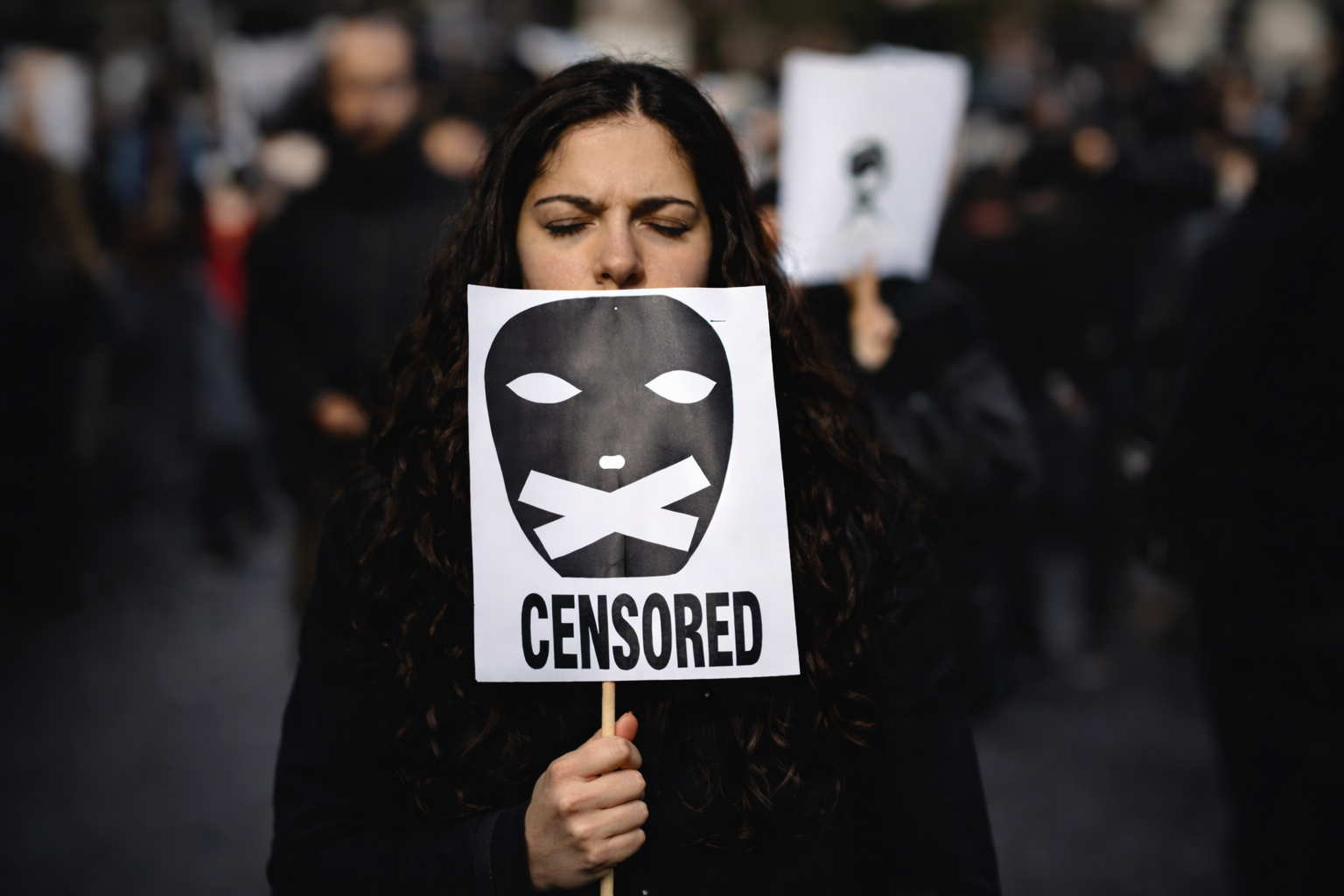
In Europe, censorship rarely arrives as a ban. It arrives as a lawsuit, a budget cut, platform dependence, and the slow shrinking of independent journalism.
In Europe, censorship no longer always looks like censorship. It does not necessarily come as a newsroom raid, a confiscated newspaper, or a journalist dragged away in public. More often, it comes dressed as something ordinary: a legal threat too expensive to answer, a newsroom too fragile to sustain difficult reporting, an advertiser no one wants to irritate, an ownership structure that narrows the range of acceptable speech, or a platform change that quietly pushes serious reporting out of sight.
The methods look softer than the old ones. Their effect can be just as effective. The point is not that Europe has returned to overt censorship everywhere. The point is that pressure on journalism is increasingly legal, economic, political and infrastructural, even where formal democratic guarantees remain in place. The Council of Europe’s 2025 press freedom report says so clearly.
It does not need a uniform
That is why the old image of censorship can mislead. If we only look for direct prohibition, we miss the more common mechanism. A reporter can still publish and still be less free. A newsroom can still operate and still become cautious, thinner, poorer and easier to intimidate. The Council of Europe’s 2025 press freedom report says plainly that press freedom across Europe remains under sustained pressure, citing legal threats, media capture, political interference and transnational repression. That is already enough to understand the problem. The real question is not only whether speech is formally allowed, but whether journalism can survive the cost of using that freedom.
When the newsroom gets poorer
The first pressure is economic. If journalism is permanently underfunded, autonomy becomes a luxury. Reporting takes time. Verification costs money. Legal review slows the cycle. All of that becomes harder to defend in a newsroom built around urgency, low margins and shrinking staff. In that setting, the safest story starts to look like the most rational one. Not because editors suddenly become censors, but because scarcity punishes ambition. A newsroom that cannot afford risk eventually learns to avoid it.
This is not a marginal issue. The 2025 Media Pluralism Monitor describes Market Plurality as the EU’s most fragile area and says both media ownership concentration and digital platform dominance are at very high-risk levels. It also notes that 18 countries still lack mechanisms to assess the impact of media mergers on pluralism, even though the European Media Freedom Act expects precisely that kind of scrutiny. When market structure becomes that fragile, editorial freedom rarely disappears in one dramatic gesture. It gets crowded out, deal by deal, cut by cut, silence by silence.
The lawsuit as warning
The second pressure is legal. A lawsuit does not have to win in court to work. Sometimes its real function is to drain time, money and nerve. That is why SLAPPs matter. They do not only threaten a single article. They threaten the conditions in which future articles are imagined and pursued. The warning arrives before the verdict does.
The European Union has already acknowledged the scale of the problem. In April 2024 it adopted Directive (EU) 2024/1069, the anti-SLAPP directive, explicitly aimed at protecting people engaged in public participation from manifestly unfounded or abusive court proceedings. The law matters because it admits something essential: in a democracy, litigation itself can be used as a weapon against scrutiny. The existence of the directive does not mean the problem is solved. It means the problem has become impossible to deny.
Platforms decide what is visible
The third pressure is distribution. A newspaper once needed printers, trucks and kiosks. Today, a large part of public visibility passes through platforms that did not create journalism but increasingly shape who sees it, when, and under what conditions. This matters because digital censorship is often subtractive. Your article remains online. Your account is not banned. You are simply shown less, found less, carried less.
That dependence is no longer hypothetical. The Reuters Institute’s 2026 trends report says average referrals to news websites from Facebook fell sharply, and the Reuters Institute’s study on young news audiences shows how strongly younger readers now meet news through social platforms. Put those two shifts together and the picture becomes clearer: journalism depends on intermediaries it does not control, while younger audiences encounter news more and more inside systems built around attention rather than public value. That is not classical censorship. It is still a structure of dependency.
Ownership still matters
None of this makes ownership less important. It makes ownership more important. When fewer hands control more of the media landscape, the room for genuine disagreement shrinks even before anyone picks up a phone. The issue is not only crude interference. It is the more ordinary question of where incentives point, which risks feel acceptable, and who is unlikely to be commissioned in the first place.
That is one reason the European turn toward ownership transparency matters. The European Media Freedom Act, adopted in 2024 as Regulation (EU) 2024/1083, establishes a common framework for media services in the internal market and explicitly aims to safeguard the independence and pluralism of media services. Alongside it, the Commission has backed a media ownership monitoring system. That is not bureaucratic ornament. It is a recognition that media pluralism cannot be defended if citizens do not know who owns the loudest voices.
What this does to journalists
Put these pressures together and something deeper happens. Journalists begin to calculate differently. A difficult investigation becomes a question of legal exposure, newsroom backing, audience reach, time, and whether the final story will survive the trip through editors, owners, advertisers, algorithms and exhausted budgets. That is where self-censorship is born. Not in a grand renunciation, but in a sequence of practical decisions that slowly narrows what gets pursued.
This is why the issue should not be reduced to morality. Journalists are often told to be brave, independent, principled. Fine. But courage without structure becomes a private burden. If institutions want free journalism, they have to defend the material conditions that make it possible. The Council of Europe’s 2025 press freedom report, the European Commission’s media ownership monitoring system and the 2025 Media Pluralism Monitor are not saying exactly the same thing in the same language, but they point in the same direction: threats to journalism are no longer reducible to physical violence or explicit state censorship. They include economic fragility, abusive litigation, ownership opacity and digital dependence.
A European problem, not a local quirk
The temptation is to treat these issues as national distortions. A bad government here, a captured broadcaster there, a lawsuit in one country, platform volatility somewhere else. That underestimates the scale of the change. The problem is increasingly European. Rules are being written at EU level because the old national frame is no longer enough. Ownership, platform power, audience measurement, legal intimidation and media concentration now move across borders faster than the institutions built to restrain them.
That is why a European answer matters. Not as a slogan, and not because Brussels automatically fixes everything, but because the market for information has already outgrown the comforting fiction that each country can solve this alone. If journalism is squeezed by transnational platforms, cross-border ownership, pan-European legal frameworks and shared commercial pressures, then media freedom can no longer be defended with a purely local imagination. The European Media Freedom Act exists for exactly that reason.
Free to publish, less able to endure
The most damaging forms of censorship today often leave the language of freedom intact. That is what makes them effective. You are free to publish, but not always free to afford the consequences. Free to investigate, but perhaps without the time. Free to denounce, but with weaker distribution, a thinner newsroom, a hostile legal environment and a market that rewards blandness over scrutiny.
So the point is not to say that nothing can be said in Europe. The point is harder, and more serious. A democracy can preserve the appearance of expressive freedom while steadily weakening the institutions that turn speech into public force. When that happens, censorship no longer needs a uniform. It has contracts, metrics, ownership charts, legal letters and ranking systems. It does not silence everything. It silences enough.

Samuel Pes
Amo la storia e la geopolitica perché mi piace capire cosa muove le persone, i Paesi e le scelte che cambiano il mondo. Scrivo di attualità internazionale e analisi geopolitica con l’obiettivo di dare contesto, collegare i fatti e rendere più chiari i processi che stanno dietro le notizie. Sono cresciuto tra cinema, letteratura e musica, con una predilezione per il punk rock: energia, idee nette, zero decorazioni inutili. Scrivere è il mio modo di trasformare curiosità e ricerca in lettura utile, accessibile e onesta.


Potrebbe interessarti anche

Gaza: non è una guerra “simmetrica”, è una guerra contro la possibilità di vivere
Confederalismo Democratico: una delle società più avanzate al mondo sull’orlo della scomparsa