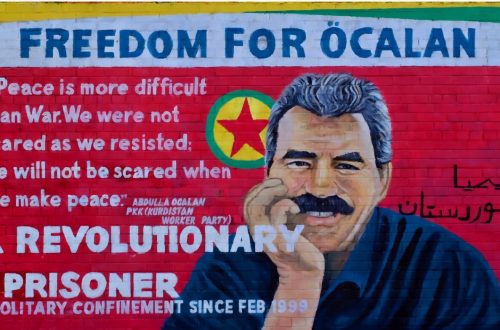
Democratic Confederalism: one of the world’s most advanced societies on the verge of disappearance

In Abdullah Öcalan’s first foundational text, Democratic Confederalism appears not just as a Kurdish political theory, but as a radical alternative to the nation-state; a society built on grassroots participation, pluralism and self-government, now threatened by war and centralism.
When people speak about Democratic Confederalism, the danger is always the same: either it gets reduced to a slogan, or it gets treated like an abstract utopia with no body, no history and no enemies. But the point is exactly the opposite. We are not dealing only with a political theory. We are dealing with a rare historical experience, with a social experiment that tries to return politics to society, pluralism to communities, and decision-making power to those who actually live in the territory. And at the same time, we are dealing with a reality that can be crushed by war, siege and the violent return of state centralism. In the opening pages of Democratic Confederalism, Öcalan describes it as a “non-state social paradigm”, based on grassroots participation, where higher levels exist mainly for coordination and implementation, while basic decision-making power remains with local institutions.
In this first text, Öcalan does not merely propose a solution to the Kurdish question. He proposes something more radical: the idea that the liberation of a people does not necessarily require a nation-state, but can emerge from a network of assemblies, communities, delegates and forms of self-government that coordinate without turning themselves into a new dominant apparatus. That is the core of the argument. Freedom, in this framework, is not automatically achieved by building a new state. It may instead mean restoring the social capacity to decide from below. Öcalan explicitly writes that the Kurdish question was never merely a matter of ethnicity or nationhood, but increasingly a question of democracy.
The critique of the nation-state is therefore the real theoretical heart of the brochure. For Öcalan, the nation-state is not a neutral form. It is the mature political form of capitalist modernity: a structure that centralizes power, expands bureaucracy, seeks homogeneity and gradually turns society into an object of administration. The problem is not only that the state governs from above; it is that, by centralizing, it seizes politics itself. People cease to act as political subjects and become material to be managed. Democracy survives more as language than as living practice. In the section on nation-state and power, Öcalan argues that capitalism and the nation-state became so closely linked that neither can really be imagined without the other, and he calls the nation-state the most developed and complete monopoly of power.
This is why Democratic Confederalism presents itself as a structural answer rather than a cosmetic reform. Decision-making power, Öcalan writes, must remain with local grassroots institutions; delegates do not replace the people’s will, but carry it and implement it for a limited time. That difference is enormous. Here politics does not climb upward in order to be absorbed by a center. It starts from below and uses higher levels only to coordinate. In this architecture, what matters is what Öcalan calls moral and political society; a society that does not hand over its entire existence to a separate apparatus. The brochure’s table of contents makes this centrality explicit, with dedicated sections on Participation and the Diversity of the Political Landscape and Moral and Political Society.
This is also why the experience can be described, without empty romanticism, as one of the most advanced political and social experiments of our time. Not because it is perfect, and not because it should be idealized, but because it tries to hold together elements that dominant modern politics has usually separated: grassroots democracy, pluralism, limits on centralized power, and a social rather than purely statist understanding of politics. When this theoretical model enters the laboratory of Rojava, it does not remain a brochure. It becomes an attempt at concrete institutional and social organization. The AANES Social Contract, in its 2023 edition, places particular emphasis on women’s freedom, democratic society, ecology, and a decentralized political order in North and East Syria.
And this is exactly where the most painful point enters. A reality like this is threatened not because it is weak in theory, but because it is too different from what surrounds it. The Social Contract of the AANES is built around principles such as gender equality, democratic decentralization, and coexistence among peoples. That already places it in sharp contrast with the centralized state forms that dominate the region. In other words, we are not looking at a simple local administration. We are looking at an attempt to institutionalize another idea of society. And that is precisely what makes it vulnerable. The Rojava Information Center’s overview of the 2023 Social Contract frames it as a foundational document for governance in North and East Syria.
The possible disappearance of this experience would therefore mean more than the loss of a local political balance. It would mean the erasure of a historical proof: the proof that one can at least attempt to imagine coexistence without relying on the classic model of the sovereign, homogenizing and vertical state. When an experience like this is besieged, compressed or gradually reabsorbed by surrounding powers, what disappears is not only a territory under autonomous administration. What disappears is a concrete example of the fact that another way of organizing power was possible. That is why Kobane stops being only a news symbol and becomes a historical one.
None of this means turning Democratic Confederalism into an object of faith. The text is extremely powerful at the theoretical level. It is clear in its critique of the nation-state and clear in the architecture of an alternative paradigm. But it is less detailed on a question that cannot be avoided: how can such a model endure under war, embargo, economic scarcity, military pressure and internal contradictions? This is not a dismissal of the project. It is the question that must remain open if we want to avoid both hagiography and cynicism. That critical inference is mine, but it follows directly from the gap between the normative force of the text and the harsh historical terrain in which that theory has tried to live. The brochure is strongest in defining principles; it is less concrete on long-term institutional endurance under hostile conditions.
And yet that is exactly why this first foundational text deserves to be taken seriously. Because it forces a reconsideration of something official politics usually treats as already settled: the assumption that freedom automatically coincides with statehood. Öcalan overturns that assumption and asks another question instead. Can a society become politically free not by building a new center of command, but by decentralizing, confederating and socializing power? Can there be a nation without statism, politics without monopoly, coexistence without homogenization? At that point the text stops speaking only to the Kurdish question and begins to address everyone.
That is why Democratic Confederalism should not be read as an ideological curiosity or as some folkloric exception of the Middle East. It should be read as one of the few contemporary theoretical and practical attempts to imagine a society more horizontal, more plural and more advanced than the dominant form of our present. And that is exactly why its possible erasure would not concern only North and East Syria . It would concern everyone. Because when an experience like this disappears, what disappears is not only a local political experiment. What disappears is a concrete proof that another way of organizing politics, coexistence and freedom was possible.

Samuel Pes
Amo la storia e la geopolitica perché mi piace capire cosa muove le persone, i Paesi e le scelte che cambiano il mondo. Scrivo di attualità internazionale e analisi geopolitica con l’obiettivo di dare contesto, collegare i fatti e rendere più chiari i processi che stanno dietro le notizie. Sono cresciuto tra cinema, letteratura e musica, con una predilezione per il punk rock: energia, idee nette, zero decorazioni inutili. Scrivere è il mio modo di trasformare curiosità e ricerca in lettura utile, accessibile e onesta.


Potrebbe interessarti anche

Il Punto di Vista: dare voce a chi voce non ce l’ha

April 25: why Liberation still matters