
Kurds between two fires: from Iran’s borderlands to Kobane
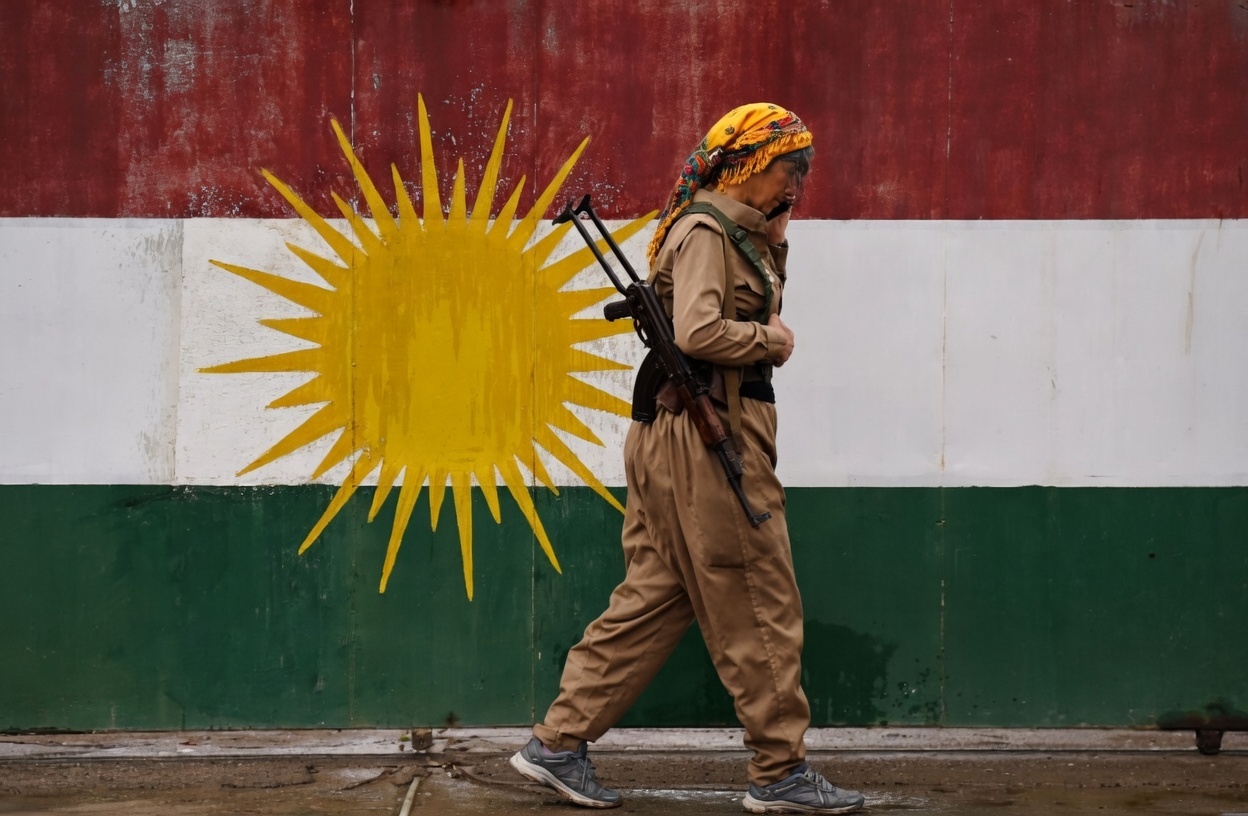
Iranian and Syrian Kurds are being squeezed by repression, siege and proxy war; even the latest voices from PJAK refuse to become anyone’s infantry.
There are moments when history does not merely trap a people between two enemies; it presses them into the same vice from opposite directions. That is where Iranian and Syrian Kurds now stand. In Iran, Kurdish opposition groups are being drawn toward the dangerous frontier where political struggle can be turned into military utility. In Syria, Kobane, has once again become the emblem of a community first praised for its resistance to ISIS and then left exposed to siege, infrastructural strangulation and strategic neglect. The histories are different, but the pressure is similar: in both cases, Kurdish communities risk becoming useful to power only insofar as they remain expendable.
When political opposition becomes a military asset
The Iranian side of the story begins with a political fact that should neither be romanticised nor dismissed. A coalition of Iranian Kurdish political forces has indeed been announced, with a public text that speaks of overthrowing the Islamic Republic, claiming self-determination, and building a national and democratic order in Iranian Kurdistan. Yet the real question is not whether this coalition exists. The real question is what sort of war it might be drawn into before it can become a coherent political subject in its own right.
Reuters reported that Iranian Kurdish militias based in Iraqi Kurdistan discussed with the United States, whether, and how, to strike Iranian security forces in western Iran. AP, meanwhile, reported that some Kurdish Iranian dissidents denied any imminent attack but said they would join a U.S. invasion if one were to come. This is not yet a settled campaign. It is something more unstable and therefore more dangerous: a political space left ajar to proxy war.
Iraqi Kurdistan as the warning bell
That danger is not theoretical. It has already produced material consequences in Iraqi Kurdistan. AP reported that figures associated with the Kurdistan Freedom Party, PAK, spoke of previous missile and drone strikes on their bases by Iran and allied militias, with deaths and injuries. Once attacks land across the border, the grammar changes. What was yesterday a feared scenario becomes today a lived condition. Before Iranian Kurds are ever “used”, they are already paying. And once the violence spills onto Iraqi territory, the message is unmistakable: the conflict is not waiting to begin; in some respects, it has already overrun its own frontier.
Repression inside Iran and the logic of collective punishment
Inside Iran, the external crisis meets an internal machinery already primed for repression. Human Rights Watch, has described a sweeping campaign of arbitrary arrests, torture and enforced disappearances after the killings of protesters and bystanders in January 2026. Amnesty International recorded more than one thousand executions in 2025, the highest annual figure it had registered in Iran in at least fifteen years. The significance is brutal in its simplicity: when war escalates, the state acquires a ready-made vocabulary for tightening its grip. Dissent becomes a fifth column. Border regions become suspect zones. Repression dresses itself in the language of national security. And when that happens, those who pay first are not the strategists of war, but the communities condemned to live beneath its categories.
Kobane and the lesson of abandoned heroism
This is where the Syrian mirror becomes indispensable. Kobane is not an aside. It is the historical proof that military usefulness does not guarantee political protection. Years after becoming the global symbol of resistance against ISIS, the town has returned to the humanitarian maps as a place under pressure, with water and electricity cut, essential services interrupted, and aid once again dependent on the arrival of UN convoys. UN aid reached Kobane while the town remained surrounded, with food, water, fuel, medical supplies and other essentials brought in under emergency conditions. Heroism, in other words, does not buy immunity. It merely delays abandonment.
Rojava, pluralism, and the pressure of centralism
The deeper significance of Kobane lies in what it reveals about Rojava as a whole. The north-east Syrian administration has never been merely a Kurdish enclave. The AANES Social Contract affirms Arabic, Kurdish and Syriac as official languages and frames the political order around democratic decentralization, women’s freedom and social coexistence. This matters because it clarifies what is at stake: not simply a territorial dispute, but a plural and multi-ethnic experiment in political life. In Syria, that pluralism is under siege. In Iran, self-determination risks being bent into the language of proxy warfare. Different histories, then, but one common trap: state centralism from one direction, external instrumentalisation from another.
The PJAK “Third Line” and the refusal of foreign tutelage
The latest and perhaps most revealing development comes from a Kurdish voice that refuses simplification. In a recent interview by Luca Foschi for Avvenire PJAK spokesperson Gulavîj Orîn rejects the Islamic Republic but also rejects the idea that Kurdish forces should be folded into a foreign-directed ground operation. Her language is strikingly clear: the Kurds, she argues, do not need Washington or Tel Aviv to authorize their struggle. She describes PJAK and its allies as a Third Line: neither submission to Tehran nor absorption into someone else’s war. Whether one agrees with that formulation or not, it introduces something essential into the discussion: Kurdish political agency cannot be reduced either to regime propaganda or to Western strategic fantasy.
Neither with the regime nor with those who use peoples as infantry
That is why this story should not be told as a contest between saviours and villains. The real dividing line is elsewhere. On one side, the Iranian regime, with its accumulated practice of repression, surveillance and punishment. On the other, the recurring temptation of outside powers to treat oppressed peoples as ground force in a war designed elsewhere. Between those two logics stand civilians and minorities, asked to carry burdens they did not choose. The question, then, is not who can claim the Kurds rhetorically. It is who allows them to remain political subjects rather than military instruments. From Iran’s borderlands to Kobane, the answer remains uncomfortably uncertain. And whenever that answer remains vague, the pattern repeats itself with dispiriting clarity: useful when needed, disposable when convenient.

Samuel Pes
Amo la storia e la geopolitica perché mi piace capire cosa muove le persone, i Paesi e le scelte che cambiano il mondo. Scrivo di attualità internazionale e analisi geopolitica con l’obiettivo di dare contesto, collegare i fatti e rendere più chiari i processi che stanno dietro le notizie. Sono cresciuto tra cinema, letteratura e musica, con una predilezione per il punk rock: energia, idee nette, zero decorazioni inutili. Scrivere è il mio modo di trasformare curiosità e ricerca in lettura utile, accessibile e onesta.


Potrebbe interessarti anche
Curdi iraniani e siriani: guerra per procura e civili sotto tiro

Gaza: l’abitudine alla catastrofe
