
The Evening Is No Longer Ours
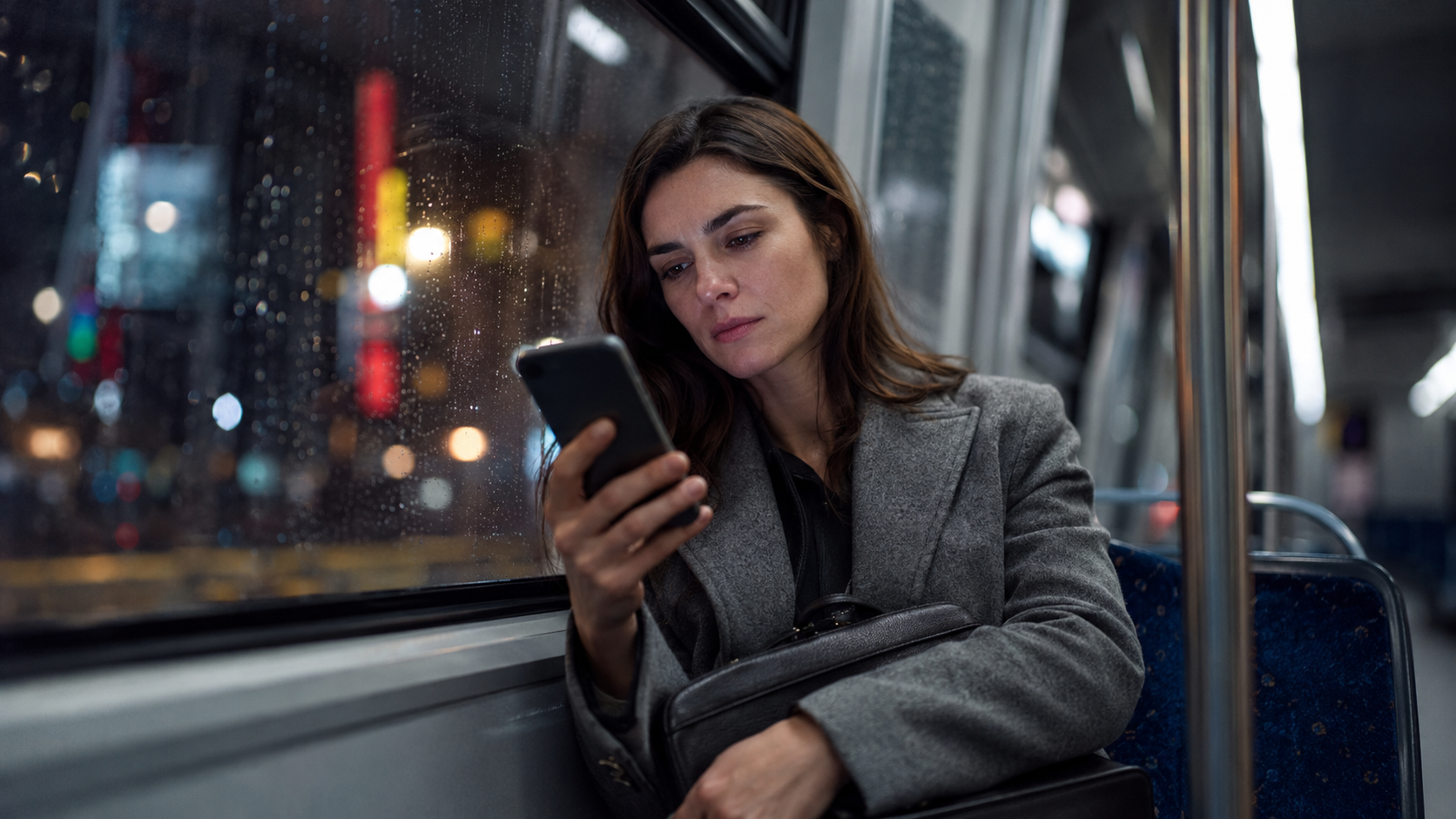
Digital work has erased many borders almost without noise: the right to disconnect tries to put a door back where there is now only a screen.
The message at 9.47
Dinner is nearly over. One plate remains on the table, a glass beside it, the sort of domestic disorder that usually means the day has finally loosened its collar. Then the telephone vibrates.
The message begins with Quick one.
Quick things sent at 9.47 in the evening possess a curious elasticity. They may take three minutes, half an hour, or the rest of the night, especially once the mind has returned to the office and refuses to find its coat again. The sender adds no rush, which is a charming expression. It removes the order from the sentence and leaves the obligation intact.
There was a time when evening had a rougher clarity. The shift ended. A gate closed, a train was caught, a shop shutter came down. People returned home carrying the day in their shoulders, shoes and temper. Work followed them as tiredness, perhaps as resentment. It usually lacked the means to continue issuing instructions from the kitchen table.
Now it enters without travelling.
It appears between a photograph, a weather alert and a message from somebody one actually loves. It has learned discretion. The modern employer rarely needs to say, “You must answer.” The employee has already heard the sentence somewhere inside himself.
The boss no longer knocks. He arrives as a notification and often finds the door politely open.
A very courteous command
Digital work speaks excellent English. Flexibility. Ownership. Agility. Availability. The vocabulary is so well behaved that one almost feels vulgar asking who benefits from it.
Flexibility once suggested a little freedom in organising one’s day. In practice it has often become a hinge fitted to only one side of the door. The organisation moves when it wishes; the worker is expected to bend without making the furniture creak.
The European Commission has begun discussing an EU initiative on the right to disconnect and fair telework, explicitly referring to the risks of an always-on culture. Telework in the Union has doubled since 2019, and in 2024 roughly one European in five worked from home for at least part of the time.
The change brought real advantages. Fewer trains, fewer hours in traffic, a little more control over the day. Anyone who has spent a wet November morning on a suburban platform need not be lectured on the moral grandeur of commuting.
The bill arrived quietly.
The laptop remained on the table after working hours. The company chat joined the family chat. The employee began to carry an office in his pocket, complete with its urgencies, its silences and its small court etiquette. A delayed reply could mean nothing. It could also look unhelpful. Modern discipline thrives in that small uncertainty.
No one orders you to answer.
Everyone notices when you do not.
The right to disappear
The phrase right to disconnect sounds as though it had been designed by a committee in a room without windows. Behind the dry wording sits a modest human request: to disappear from work for a few hours without being suspected of desertion.
The figures collected in Eurofound’s study of company-level disconnection policies are revealing. Eight workers out of ten in the survey said they regularly received work communications outside contractual hours. Nearly one in five reported doing additional work because they had been contacted after hours. Employees in companies with a disconnection policy described better work-life balance and greater job satisfaction, though the policy alone did not prevent the messages from arriving.
Naturally. A rule may switch off a server. It has greater difficulty switching off fear.
The most effective command is the one that has been absorbed. A worker answers at night because the client is waiting, the manager is active, the colleague has already replied, the contract is temporary, the promotion is delicate, the next restructuring is never entirely imaginary. None of this needs to be written in capital letters.
The reachable employee appears conscientious. He may simply be more vulnerable.
He lives in a mild state of alarm, without the dignity of an emergency. A small office casualty department opens every evening in the sitting room. Nobody bleeds. Everybody checks the phone.
This matters beyond fatigue. Time outside work is where people remain more than their occupation. They cook badly, read slowly, argue, care for somebody, stare through a window, waste an hour with considerable talent. Even boredom has a civic function. A person denied useless time eventually loses something besides rest. He loses the chance to become opaque to those who employ him.
A British cup of tea, a European problem
The English-speaking workplace often presents overwork as temperament. Some people are said to be driven. Others are team players. A manager sends emails before breakfast because he is passionate; an employee answers them because she is committed. The arrangement is admired until somebody collapses, at which point resilience workshops are usually organised.
Across continental Europe the language may sound more legal, with rest periods, collective agreements and statutory protections. In Britain it often arrives dressed as good management, wellbeing or common sense. The difference is less substantial than it first appears. The same telephone lies face up beside the same cooling tea.
The real divide runs elsewhere. It separates those who can ignore the message from those who cannot.
A senior professional may close the laptop and call it boundary-setting. A junior employee performing the same gesture risks appearing insufficiently keen. A secure worker can defend an evening. A precarious worker rents it out in small pieces, often without knowing the price.
This is where the discussion leaves the pleasant territory of lifestyle advice. It becomes a question of power.
People are often told to manage their notifications, as though the problem began in the settings menu. Turn off alerts. Leave the telephone in another room. Establish a routine. All sensible suggestions. One might also advise a tenant to relax while the rent rises. Individual composure has become the little handkerchief offered whenever structural pressure starts to sweat.
Our article Across Europe, the city is becoming a luxury described workers still required by cities that increasingly refuse to house them. Digital labour produces a related elegance. The city consumes the salary; the job consumes the evening. Between them, they leave the worker a very efficient life and remarkably little of his own.
The algorithm keeps excellent hours
The platform worker knows this arrangement in its purest form. His manager may have no office, no face and no bad tie. It appears as a score, an allocation, a route, a warning, a sudden loss of access. It neither sleeps nor feels embarrassed.
The European rules on platform work were adopted to address the employment status and algorithmic management of more than 28 million people working through digital labour platforms in the EU. Automated systems must be supervised by qualified staff, workers must be able to contest automated decisions, and national systems must provide a legal presumption of employment where facts indicate control and direction.
The terminology is technical. The quarrel is ancient.
Who gives the order? Who carries the risk? Who is free to refuse? Who waits unpaid for work that may arrive?
The algorithm has improved the costume. Dependence can now look like independence on a clean screen. The rider selects his hours, provided the platform offers work. He is free to decline, provided declining does not alter his rating, income or future access. He owns the bicycle and, with touching generosity, much of the risk.
The old employer left fingerprints. The machine leaves metrics.
Algorithmic control has also travelled beyond delivery work. It enters warehouses, call centres, offices, newsrooms and schools. Productivity becomes visible by the minute. The worker is translated into response times, tasks closed, keystrokes, routes and output. Measurement arrives claiming modesty. It merely wishes to help. Soon afterwards, everything that cannot be measured begins to look suspicious.
Technology does not create this appetite. It gives the appetite better cutlery.
The same mechanism appears in the language surrounding artificial intelligence and employment. Our piece on AI, journalism and the convenient alibi of innovation examined how technological necessity can be used to perfume decisions already desired by ownership and management. The machine receives the blame, the balance sheet receives the benefit, and the worker is invited to admire progress while clearing the desk.
The annexation of the home
No declaration announced that the home had been partially annexed by work. The occupation proceeded with better manners.
First came the occasional email. Then the group chat, useful for urgent matters. Urgent matters multiplied, as they do when given their own icon. The shared document arrived next. Then the meeting at six thirty, placed there because everyone was free. Everyone was free because the working day had supposedly ended.
The kitchen became a conference room with fruit in the background. Bedrooms acquired neutral walls for video calls. Partners learned to lower their voices during meetings. Children discovered that a parent could be physically present and administratively elsewhere.
Much of this was accepted willingly. That is part of the story and should not be tidied away. Remote work helped carers, disabled workers, parents and people living far from large cities. It saved time and made some workplaces less exhausting. The freedom was real.
So was the seepage.
The office used to occupy space. Digital work occupies attention. Space can be left. Attention follows one into the shower, through dinner, into bed. The unfinished task sits beside the lamp with the composure of a guest who has no intention of leaving.
Managers sometimes say that nobody is expected to answer after hours. Then they continue sending messages after hours. A delicate distinction follows. The message is voluntary for the recipient and apparently irresistible for the sender.
Corporate culture is full of such minor miracles.
Pressure without uniforms
Power has grown fond of appearing as atmosphere. It seldom needs the crude sentence when a suggestion, habit or expectation will do. This is one reason digital labour belongs to a larger European question about soft forms of pressure.
In Censorship without uniforms: how media pressure works today, we looked at systems that narrow freedom without formally banning anything. Economic dependence, legal exposure and platform control can alter behaviour while leaving the democratic furniture in place.
The workplace offers its own version. Nobody forbids the evening. It simply becomes professionally unwise to inhabit it completely.
A worker learns to anticipate the employer’s need. The email is answered before the request hardens. The weekend call is taken with a laugh. Holidays remain available for genuine emergencies, a category whose borders tend to expand in direct proportion to managerial convenience.
The injury is hard to dramatise. There is no factory siren, no locked gate, no foreman with a stopwatch. There is a blue light on a face at eleven twenty-three.
That modest image contains the whole arrangement.
Putting the door back
The right to disconnect will never be enough on its own. A sentence in a policy cannot repair workloads designed for permanent overflow. It cannot protect a precarious employee if refusal still carries an unofficial cost. It cannot create rest where understaffing has already spent it.
It can draw a line.
Lines matter because work has always needed limits imposed from outside its appetite. The working day, paid leave, weekly rest and safety rules were never produced by the spontaneous good taste of the market. They came from conflict, law and organisation. Employers adjusted. Civilisation somehow survived.
An evening free from work belongs to the same history.
It is not a reward for having been productive. It is part of the human arrangement that makes work tolerable. It allows affection to escape scheduling, thought to escape output, and the body to stop presenting evidence of usefulness.
A person should be able to become unavailable without composing a defence.
The telephone will remain on the table. The message may still arrive. The right begins at the moment when silence stops looking like guilt.
The last small employee
At ten fourteen another email appears. The subject says For tomorrow. The body makes clear that tomorrow would be improved by a reply tonight.
The recipient looks at it. In that brief pause, the entire politics of digital work becomes visible. There is the contract, the manager, the mortgage, the ambition, the fear of seeming difficult, the old wish to be regarded as reliable. There is also a half-finished conversation across the table.
Inside nearly everyone lives a small diligent employee. He dislikes delay, keeps imaginary minutes, and is always ready to sacrifice an evening to avoid a discomfort in the morning. The digital workplace has learned to address him directly.
A serious right to disconnect would give the rest of the person a chance to answer.
The evening is no longer ours when work remains present even in its silence, when the screen needs only to light up for the room to change character. Recovering it will require more than turning off a device. It requires a decision about the limits of power and the ownership of time.
A society that cannot switch work off has not become more industrious.
It has merely organised its exhaustion.

Samuel Pes
Amo la storia e la geopolitica perché mi piace capire cosa muove le persone, i Paesi e le scelte che cambiano il mondo. Scrivo di attualità internazionale e analisi geopolitica con l’obiettivo di dare contesto, collegare i fatti e rendere più chiari i processi che stanno dietro le notizie. Sono cresciuto tra cinema, letteratura e musica, con una predilezione per il punk rock: energia, idee nette, zero decorazioni inutili. Scrivere è il mio modo di trasformare curiosità e ricerca in lettura utile, accessibile e onesta.


Potrebbe interessarti anche

Kobane: l’assedio come arma politica contro i civili

Gaza: The Habit of Catastrophe
