Gaza: The Habit of Catastrophe

Gaza reaches Europe as a daily bulletin of rubble, hunger and diplomatic concern. The disaster remains intolerable. Our attention has learned to live with it.
At half past seven Gaza appears on a kitchen screen somewhere in Britain. A road cut through grey rubble. A woman carrying water. A child holding a saucepan with both hands. The presenter lowers her voice by half a tone, as presenters do when suffering has been placed between the weather and the football.
Then the programme moves on.
No malice is required. The kettle boils, trains are delayed, interest rates remain disagreeable. The catastrophe has entered the furniture of the morning. It is seen, regretted and put away. By eight o’clock, Gaza has become something that happened again.
Nothing is ordinary there. The habit is ours.
A catastrophe becomes bearable at a distance through repetition. The first destroyed hospital shocks. The fifth is evidence of a pattern. The twentieth enters a table. A hungry child is a scandal. A hundred thousand children at risk of malnutrition become a humanitarian estimate, soberly typed and released with a logo at the top.
The figures are necessary. Without them, power enjoys the privacy of vagueness. Yet numbers also possess a dark courtesy. They arrange pain so that institutions can receive it during office hours.
A ceasefire with gunfire in it
The ceasefire announced in October 2025 improved humanitarian access and pushed back the most extreme conditions of famine. It also acquired one of the strangest meanings in contemporary diplomacy. Fighting continued, civilians continued to die, displacement continued near restricted areas, and Gaza remained a place where a formal word and daily life could pass each other without speaking.
The United Nations humanitarian report of 10 July 2026 describes people confined to a reduced part of the Strip, exposed to military activity, overcrowding, poor shelter and limited access to medicine, water and sanitation. New displacement continues along the so-called Yellow Line. Humanitarian space contracts while the vocabulary of stabilisation expands.
The name is almost elegant. Yellow Line. It might belong to an underground map.
On the ground it marks fear, lost space and another hurried departure. A mattress is rolled. A bag is closed badly. Somebody looks once more at a room already borrowed from an earlier displacement. The great geopolitical nouns come later.
Hamas’s murder of civilians and taking of hostages on 7 October 2023 remain crimes. The hostages must be released. The sentence needs no disguise and no reluctant footnote. It also cannot function as a renewable permit for the destruction of civilian life.
Security has been asked to carry too much moral luggage. Under its name, homes, hospitals, schools, water systems and the elementary routines of existence have been reduced to negotiable matter. When everything needed for life becomes conditional, war moves beyond the battlefield. It enters the tap, the pharmacy shelf, the route of an ambulance, the price of flour.
The respectable face of hunger
Hunger is rarely theatrical for long. It begins with the missing item, the smaller portion, the meal postponed so that a child may eat. The body learns thrift before the political world learns alarm.
The latest IPC assessment of food insecurity in Gaza found that more than 1.2 million people faced Crisis or worse conditions between mid-April and the end of June 2026. The figure is projected to rise above 1.4 million during the second half of the year. Two hundred and twelve thousand people are expected to remain in Emergency conditions.
The report explains that large-scale assistance brought real improvements after the ceasefire. It also describes gains resting on collapsed livelihoods, restricted land, scarce agricultural inputs and an aid system whose coverage has already begun to shrink.
This is progress in the peculiar grammar of disaster. Famine is pushed back, and crisis becomes the acceptable result. Death at its most rapid has been avoided. Life remains thin, dependent and supervised.
The British government recently observed that avoiding famine cannot be treated as success. The remark is accurate and rather devastating. In a healthier political age, it would be unnecessary. Europe and Britain have reached the point of reminding themselves that people need more than the minimum conditions required not to starve in public.
A bag of flour enters Gaza after inspections, permissions, delays and announcements. By the time it reaches a family, it has acquired a diplomatic biography.
The continent of grave concern
Europe has developed a phrase for Gaza: grave concern.
It appears in statements with admirable stamina. Concern deepens, increases, is reiterated, expressed and shared. It has travelled through more meetings than many refugees will travel through safe corridors.
The European Union is also a major humanitarian donor. This matters. Food, medical supplies, water systems and shelters are not rhetorical objects. In July 2026, the Commission and international partners launched the Team Gaza Initiative, with nearly €900 million intended for water, sanitation, health, energy, debris removal, agriculture and food systems.
The money is needed. The scene surrounding it remains uncomfortable.
Europe helps finance the repair of what political pressure failed to protect. It prepares reconstruction while destruction has not entirely ceased. It speaks of Palestinian rights, international law and a two-state settlement, then returns to the slow machinery of unanimity, national caution and strategic friendship.
The cheques travel rather better than the decisions.
This does not make European aid cynical. Much of it saves lives. It reveals a division of labour that the continent has learned to tolerate. Power destroys or permits destruction. Humanitarian policy arrives with water tanks, tarpaulins and forms. Diplomacy regrets the circumstances. The three activities meet in Brussels and call the result coordination.
Europe is neither absent nor powerless. It is selective. Trade, diplomatic recognition, arms policy, association agreements and political access all contain leverage. The continent simply becomes much more philosophical when the ally under discussion is useful.
The British room
Britain watches Gaza from a room of its own, connected to Europe and forever explaining the distinction.
The language in Westminster has changed. The State of Palestine has been recognised. Ministers speak more openly of restrictions on aid, repeated displacement and the collapse of water and health services. British money supports humanitarian agencies and plans for recovery. These are meaningful steps.
Still, the old Atlantic reflex remains in the walls. Israel is treated as a strategic partner whose conduct produces concern, while other states committing comparable acts would discover the quicker vocabulary of sanctions, isolation and moral clarity.
The double standard need not be shouted to be effective. It lives in the interval between two verbs. An adversary violates. An ally responds excessively. An adversary targets civilians. An ally faces difficult circumstances. The dead do not benefit from the grammatical care.
English-language news has often covered Gaza with courage, especially through Palestinian journalists working under appalling conditions. It has also developed habits of distance. Palestinian death arrives in the passive voice. Buildings are struck. People are killed during operations. Aid fails to enter. Responsibility becomes fog precisely when the facts become hardest to look at.
We examined this quieter machinery in Censorship without uniforms. Public debate does not always need a formal ban to narrow itself. Access, ownership, institutional caution and the fear of appearing partisan can sand down a fact until it is safe enough to broadcast.
The result is journalism that records suffering and occasionally misplaces the author of it.
The administration of survival
Gaza is often described as a humanitarian crisis. The expression is correct. It can also hide the political verbs.
Water does not merely become scarce. Pumps require electricity and fuel. Pipes are damaged. Repairs require equipment and access. Deliveries pass through crossings controlled by decisions. Patients do not simply fail to reach treatment. Roads, permits, security zones and evacuation procedures stand between illness and care.
Survival has been turned into administration.
A person queues for water. Another queues for food. A mother tries to place a child on a list for medical evacuation. A family waits for a tent, then for permission to move the tent, then for news that the area containing the tent may no longer be safe. Each act appears modest when written separately. Together they form a government of exhaustion.
The occupying power, armed groups, international agencies, donors and intermediaries all enter this landscape with different responsibilities and capacities. They do not stand on equal ground. Pretending otherwise produces the comfortable diagram of a conflict and loses the reality of power.
Gaza is fenced, watched and dependent on decisions made beyond the reach of its civilians. This fact does not absolve Hamas of its crimes or its authoritarian rule. It tells us who possesses the greater control over territory, access, airspace, firepower and the material conditions of life.
One may dislike the conclusion. The pipes remain unimpressed.
The regional habit
Europe has practised this distance elsewhere. A population becomes visible during siege, invasion or displacement, then fades into the less photogenic labour of surviving.
In Kurds between two fires, we looked at communities treated as useful when they fit a strategic need and inconvenient when their rights demand a durable political cost. Gaza belongs to a different history, with its own actors and wounds. The European reflex is familiar. Sympathy is plentiful during emergency. Consistency becomes scarce when power must be confronted.
The region is often described in Europe as though violence grew naturally from its soil. Ancient hatreds, endless conflict, tribal divisions. These expressions excuse the observer. History becomes climate.
There is history, of course. There is also policy. Borders were drawn, occupations maintained, weapons supplied, alliances protected, resolutions ignored and populations left for decades in arrangements called temporary. Nothing is more permanent than the political solution that everyone agrees cannot continue.
The Middle East is not condemned to repetition by temperament. Repetition is organised.
The photograph no longer shocks
The moral danger lies partly in the image.
At the beginning of a catastrophe, a photograph opens a wound in public attention. Later, a similar photograph confirms what the viewer already knows. Rubble. Dust. A child. A plastic container. The eye recognises the elements and moves more quickly.
This is not personal cruelty. Human attention defends itself. Nobody can inhabit every suffering presented by a screen. Politics begins where that understandable defence is converted into permission.
Governments know that outrage tires. Newsrooms know that audiences drift. Military campaigns and systems of control can survive public anger if they last longer than the anger’s natural life.
Time becomes an ally of power.
The daily image also risks turning Palestinians into permanent victims, bodies waiting for food, treatment or burial. Gaza contained teachers, mechanics, students, musicians, civil servants, shopkeepers, grandparents with tedious advice, children who disliked homework. It still does.
To reduce a population to suffering is another way of taking away its political existence. Compassion watches people endure. Solidarity asks why endurance has become their assigned condition.
The reconstruction photograph
Reconstruction has its own preferred picture. Officials in hard hats stand beside a plan. A school reopens. Pipes are laid. A child receives a new exercise book. Europe likes this stage. It contains budgets, projects, partnerships and measurable outcomes.
Gaza needs rebuilding on a scale that language barely holds. Homes, hospitals, roads, water networks, schools, businesses and public institutions have been destroyed or damaged. Debris itself has become a territory.
Reconstruction without political freedom can become maintenance of the next catastrophe.
A wall is rebuilt while the system capable of destroying it remains intact. A clinic reopens while access to medicine remains conditional. A neighbourhood rises under the same insecurity that emptied it. Donors return years later with another emergency package and slightly improved logos.
The difficulty is not finding concrete. It is preventing reconstruction from becoming an interval between ruins.
Restoring scandal
The first task is to recover the meaning of ordinary words.
A ceasefire should involve an end to killing. Humanitarian access should not depend on diplomatic weather. A hospital should be a hospital. Hunger should not be a bargaining instrument. International law should not change strength according to the flag involved.
This is not radical language. It sounds radical because the minimum has been pushed so far away.
Europe and Britain will continue to issue statements, fund aid and discuss political frameworks. Some of that work is serious and indispensable. The measure lies elsewhere: whether policy changes the conditions faced by civilians, or merely describes them with increasing precision.
Gaza cannot remain a moral examination that Western governments repeatedly fail and solemnly agree to resit.
There will be another morning bulletin. Another road, another queue, another diplomatic sentence containing the word concern. The kettle will boil. The programme will move on.
The habit can still be broken.
It begins when catastrophe stops being treated as a durable form of government, when civilian life is no longer weighed against strategic convenience, when the protection promised by law is applied before the rebuilding contracts are signed.
Gaza has not become accustomed to catastrophe.
It has been forced to live inside it.
We are the ones in danger of finding it familiar.

Samuel Pes
Amo la storia e la geopolitica perché mi piace capire cosa muove le persone, i Paesi e le scelte che cambiano il mondo. Scrivo di attualità internazionale e analisi geopolitica con l’obiettivo di dare contesto, collegare i fatti e rendere più chiari i processi che stanno dietro le notizie. Sono cresciuto tra cinema, letteratura e musica, con una predilezione per il punk rock: energia, idee nette, zero decorazioni inutili. Scrivere è il mio modo di trasformare curiosità e ricerca in lettura utile, accessibile e onesta.


Potrebbe interessarti anche
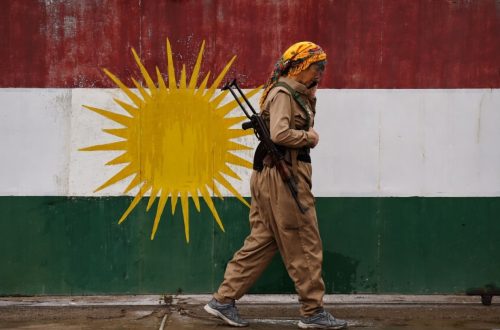
Kurds between two fires: from Iran’s borderlands to Kobane

Gaza: non è una guerra “simmetrica”, è una guerra contro la possibilità di vivere