
Democratic Nation: the society that refuses to become a state
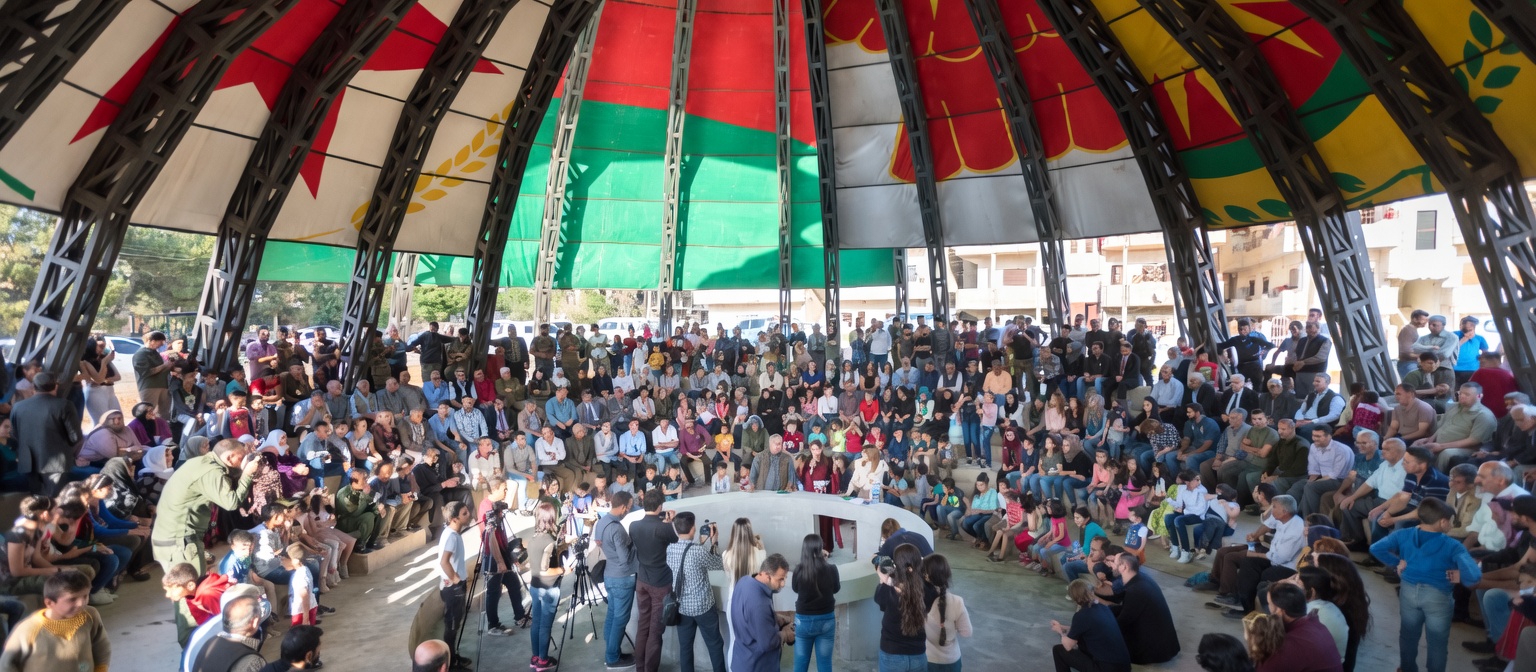
In Democratic Nation, Abdullah Öcalan imagines a political community built on pluralism, self-government and grassroots participation. That is precisely what makes it so difficult to tolerate and so easy to target.
There is something almost scandalous in Democratic Nation: it dares to ask whether a people can become politically free without first becoming a state. In a world trained to think that sovereignty, borders, bureaucracy and armed institutions are the only serious grammar of politics, Abdullah Öcalan proposes something far more unsettling. He suggests that a nation does not have to harden into a state in order to exist. It can instead organize itself as a political society, plural, self-governing, morally grounded, and capable of deciding from below. That is not just a theoretical move. It is a direct challenge to one of the deepest dogmas of modern politics.
This is what makes the book more than a Kurdish text about Kurdish problems. Democratic Nation is not a plea for delayed statehood, nor a softer nationalism in search of better branding. It is an attempt to break the equation between liberation and state-building. Öcalan argues that the nation-state is not a neutral container into which freedom can simply be poured. It is a structure tied to monopoly, homogeneity and the concentration of power. Once politics is locked inside that form, society tends to shrink into administration, and citizens into manageable units. Democracy survives, perhaps, as ritual language — but less and less as lived power.
The boldness of the book lies in the alternative it proposes. Öcalan does not define a nation primarily through borders, ministries or military institutions. He treats it first as a shared political and cultural consciousness: a community capable of recognizing itself, organizing itself and acting collectively without collapsing into statist command. In that sense, a democratic nation is not an unfinished state. It is something else entirely. It is a society that chooses to remain political without surrendering itself to a single center.
That is where the concept becomes dangerous and interesting. Because if politics can actually live in communities, assemblies, local structures, autonomous institutions and social participation, then the state loses its claim to inevitability. Öcalan’s argument is not that coordination should disappear. It is that coordination should not become domination. Delegation should not become confiscation. Representation should not become the burial of public life. A society, in this view, is strongest not when it builds the tallest center, but when it keeps political energy distributed across its own body.
The key word here is politicization. A people does not become free simply by being recognized on paper. It becomes free when it learns to deliberate, decide, organize and defend its own collective existence. That is why democratic autonomy matters so much in the book. It is not decorative vocabulary. It is the practical expression of a society that refuses to outsource its entire life to a state machine. In Öcalan’s framework, autonomy is not withdrawal from politics; it is politics brought back home.
This is also why the book matters far beyond theory. Once these ideas enter the terrain of Rojava and North and East Syria, they stop being speculative. They become an attempt, incomplete, pressured, contradictory, but real, to institutionalize another political logic. The 2023 AANES Social Contract places democratic society, women’s freedom, ecology and decentralization at the center of governance. That matters because it shows that the language of Democratic Nation did not remain trapped in essays and manifestos. It tried to become public order, civic structure and social practice.
And that is exactly why this experience is so vulnerable. Not because it is theoretically weak, but because it is politically excessive for the world around it. A society that tries to live without fully surrendering itself to the nation-state challenges too many assumptions at once. It questions centralism. It resists homogenization. It makes room for plural identities. It expects politics to be participatory rather than merely administrative. In a region shaped by siege, war, authoritarian state traditions and geopolitical predation, that kind of experiment does not simply look fragile. It looks intolerable.
This is where Kobane stops being only a battlefield and becomes a warning. What is at stake is not just the military survival of a place, but the survival of a political possibility. If an experiment grounded in pluralism, grassroots participation and non-statist political organization is gradually crushed, what disappears is not merely a local exception. What disappears is evidence, however partial, however embattled, that another form of political life was possible. That is what gives this book its urgency. It is not just describing a model. It is standing next to a historical wager that may still be lost.
None of this means that Democratic Nation should be treated as sacred scripture. It has its limits. It is stronger in architecture than in institutional detail, stronger in political horizon than in the mechanics of endurance under embargo, militarization and prolonged war. The tension between decentralization and coordination does not vanish just because one writes beautifully about freedom. The question of how such a model survives hostile material conditions remains open and it should remain open, unless one wants propaganda instead of thought. This critical point is an inference, but it follows directly from the gap between the richness of the model and the brutality of the terrain in which it is expected to live.
Still, that gap is not a reason to dismiss the book. It is a reason to read it more seriously. Because Democratic Nation asks a question that mainstream politics works very hard to avoid: can a society become more politically alive by refusing to become a state? If the answer is even partly yes, then what is under threat in North and East Syria is not just an administration, nor a temporary wartime structure. It is a counter-example. A living reminder that politics does not have to mean monopoly, and that a nation does not have to harden into a machine in order to exist.

Samuel Pes
Amo la storia e la geopolitica perché mi piace capire cosa muove le persone, i Paesi e le scelte che cambiano il mondo. Scrivo di attualità internazionale e analisi geopolitica con l’obiettivo di dare contesto, collegare i fatti e rendere più chiari i processi che stanno dietro le notizie. Sono cresciuto tra cinema, letteratura e musica, con una predilezione per il punk rock: energia, idee nette, zero decorazioni inutili. Scrivere è il mio modo di trasformare curiosità e ricerca in lettura utile, accessibile e onesta.


Potrebbe interessarti anche

Gaza 2: il fiume umano degli aiuti

Il Punto di Vista: An Independent Voice for the Overlooked
